01
Trade & Integration
Moving people, cargo and goods across African borders.
- —Aviation
- —Border delays
- —Shipping routes
- —Payments
- —Tariffs
- —Continental trade integration
PanAfriWoke Intelligence Report
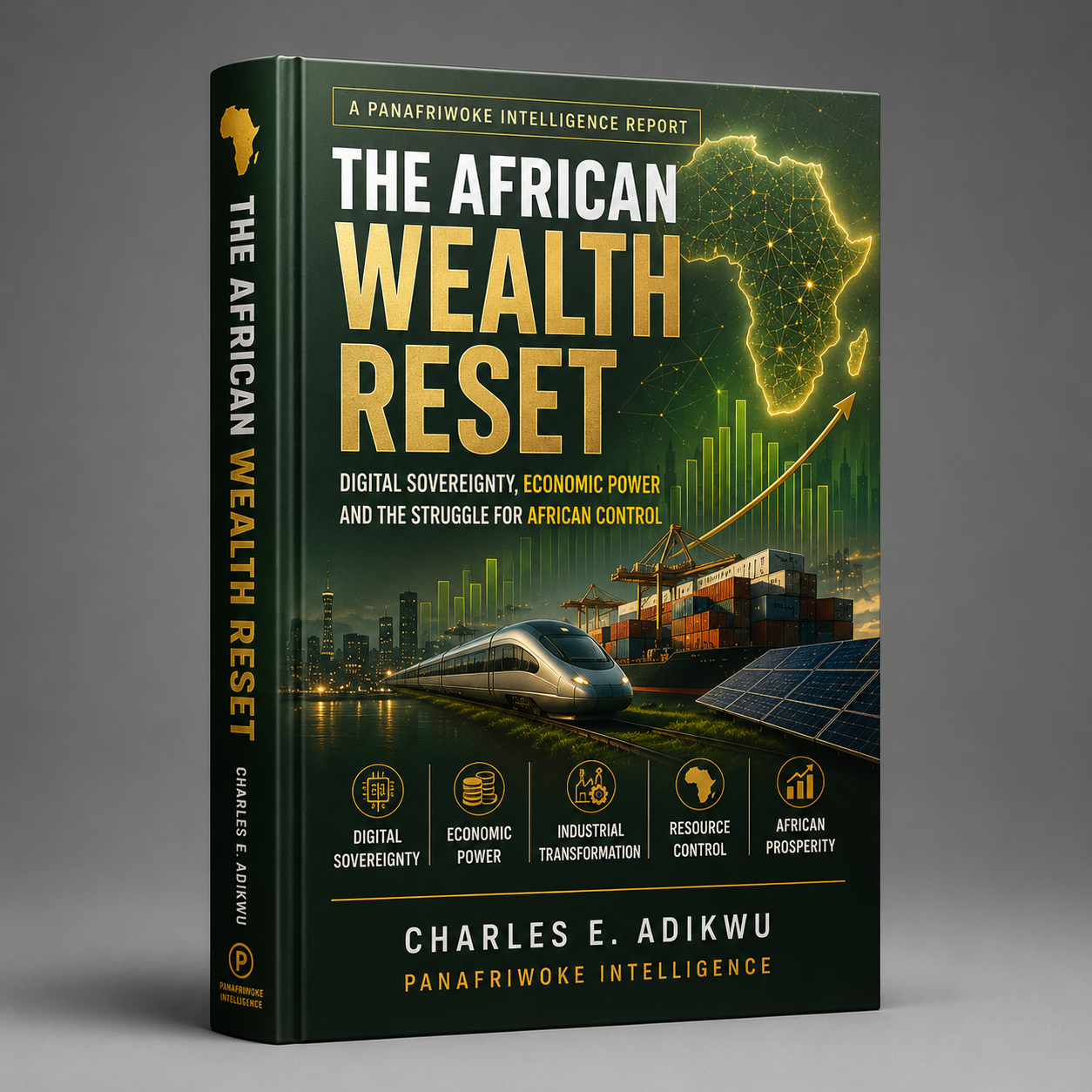
The African Wealth Reset
Digital Sovereignty, Economic Power and the Struggle for African Control
Africa can be rich in resources and still capture too little of the value those resources create.
The African Wealth Reset examines the systems behind that contradiction—from trade and logistics to agriculture, critical minerals, finance, markets and infrastructure—and asks the harder question:
How can African production, African capital, African consumers and African resources generate more value inside Africa?
A PanAfriWoke Intelligence economic research report by Charles E. Adikwu. International buyers: your checkout will show the applicable payment/currency options through Selar where available.
The Question
A resource beneath the ground is not automatically prosperity.
A cocoa tree does not automatically create a chocolate industry.
Crude oil does not automatically create a refining industry.
A mineral deposit does not automatically create batteries, industrial technology or manufacturing capability.
The report examines what happens between African resources and the final value created from them.
Value chain
What the report examines
The report does not treat Africa's economic challenges as isolated problems. Trade, agriculture, minerals, finance, manufacturing and infrastructure are connected.
01
Moving people, cargo and goods across African borders.
02
Who captures value from what African farmers and producers create?
03
Africa's minerals and energy resources are only the beginning of the value chain.
04
Who controls the financial and consumer systems through which African businesses grow?
05
Industrialization requires systems that connect production to markets.
Signature framework
Conceptual framework derived from the report's central value-capture analysis. Economic value can be created at multiple stages.
The report examines the infrastructure, institutions, financing, policies and industrial capabilities that determine whether resources become durable economic value.
01
02
03
These are conceptual frameworks, not numerical claims.
What you'll learn
Why infrastructure, trade and logistics determine whether African markets can actually function as an integrated economic system.
Why producing a commodity is only one stage of an economic value chain.
Why processing, refining, manufacturing and branding matter to African value capture.
Why monetary systems and the cost of capital influence industrial development.
Why electricity, machinery, transport and financing must be treated as interconnected industrial infrastructure.
Why economic sovereignty is not one policy, but an ecosystem of capabilities.
Chapter preview
Where does African economic value go—and what would it take to capture more of it?
Part I
Chapters 1–5
Moving around Africa. Shipping. Payments. Tariffs. Building a continent that trades with itself.
Part II
Chapters 6–8
Food imports. Agricultural inputs. Cocoa, cashew and coffee. Fishing. Fertilizer. Food systems.
Part III
Chapters 9–11
Lithium and cobalt. Raw mineral exports. Oil. Gold. Bauxite. Refining. Mining contracts. Royalties.
Part IV
Chapters 12–14
Monetary sovereignty. Local-currency trade. Manufacturing finance. Sovereign wealth. Retail markets. Textile manufacturing.
Part V
Chapter 15
Electricity. Renewable power. Local content. Industrial parks. Machinery. Railways. Pharmaceutical sovereignty.
The core idea
A factory cannot operate competitively without reliable electricity.
Reliable electricity alone does not create manufacturing if machinery is prohibitively expensive.
Machinery does not create industrialization if businesses cannot obtain affordable financing.
Financing does not solve the problem if products cannot cross borders efficiently.
The systems have to work together.
Readership
The report is not investment advice and is not presented as financial advice.
Method
The report is structured as an intelligence investigation rather than a conventional economic textbook. It begins with visible economic problems and follows them toward the deeper structural questions behind them.
Verified Data
Claims supported by credible sources.
Illustrative Example
Concrete cases used to clarify wider issues without treating one example as universal proof.
Investigative Question
Issues that require further scrutiny rather than being presented as settled fact.
Strategic Analysis
Interpretation of what the evidence means for African policy, business and institutional strategy.
The report
Digital Sovereignty, Economic Power and the Struggle for African Control
By Charles E. Adikwu
PanAfriWoke Intelligence
What you receive
International buyers: your checkout will show the applicable payment/currency options through Selar where available.
The final evidence edition distinguishes verified data, illustrative examples, investigative claims and strategic analysis.
The report's evidence base prioritizes authoritative institutional sources and clearly qualifies claims that vary by country, corridor, commodity or year.
About the report
Charles E. Adikwu
PanAfriWoke Intelligence
The African Wealth Reset is published by PanAfriWoke Intelligence: African geopolitical and economic intelligence presented in an accessible, evidence-conscious format.
The question is whether Africa can capture more of the value that its wealth creates.
The African Wealth Reset
Digital Sovereignty, Economic Power and the Struggle for African Control
Charles E. Adikwu · PanAfriWoke Intelligence
Continue the investigation
Who Controls Data, Infrastructure, and Digital Future
View report
Treaties, Contracts, Borders, and the Fight for Sovereignty
View report
How Africans Abroad Can Turn Citizenship, Capital, Skills, Land and Political Power into African Influence
View report